
Beyond the hype: Five surprising truths about AI in business that you need to know in 2026
Today's executives face a strategic dilemma: the pressure to introduce artificial intelligence is enormous, but the market is characterized by contradictory buzzwords and complex technologies. Confusion about whether a standard tool, an autonomous agent system, or a completely in-house development is the right architectural solution leads to bad investments and strategic uncertainty.
However, the success of an AI implementation does not depend on choosing the "smartest" model. It is determined by strategic decisions that focus on cost, control, security, and future viability. The key question is which architecture generates maximum business value with minimum risk and ensures long-term defensibility.
This article cuts through the hype and presents five of the most surprising and powerful insights from real-world experience. They are intended to provide clarity and give you a solid foundation for your strategic AI decisions in 2025.
Fact 1: The "make-or-buy" dilemma is misleading
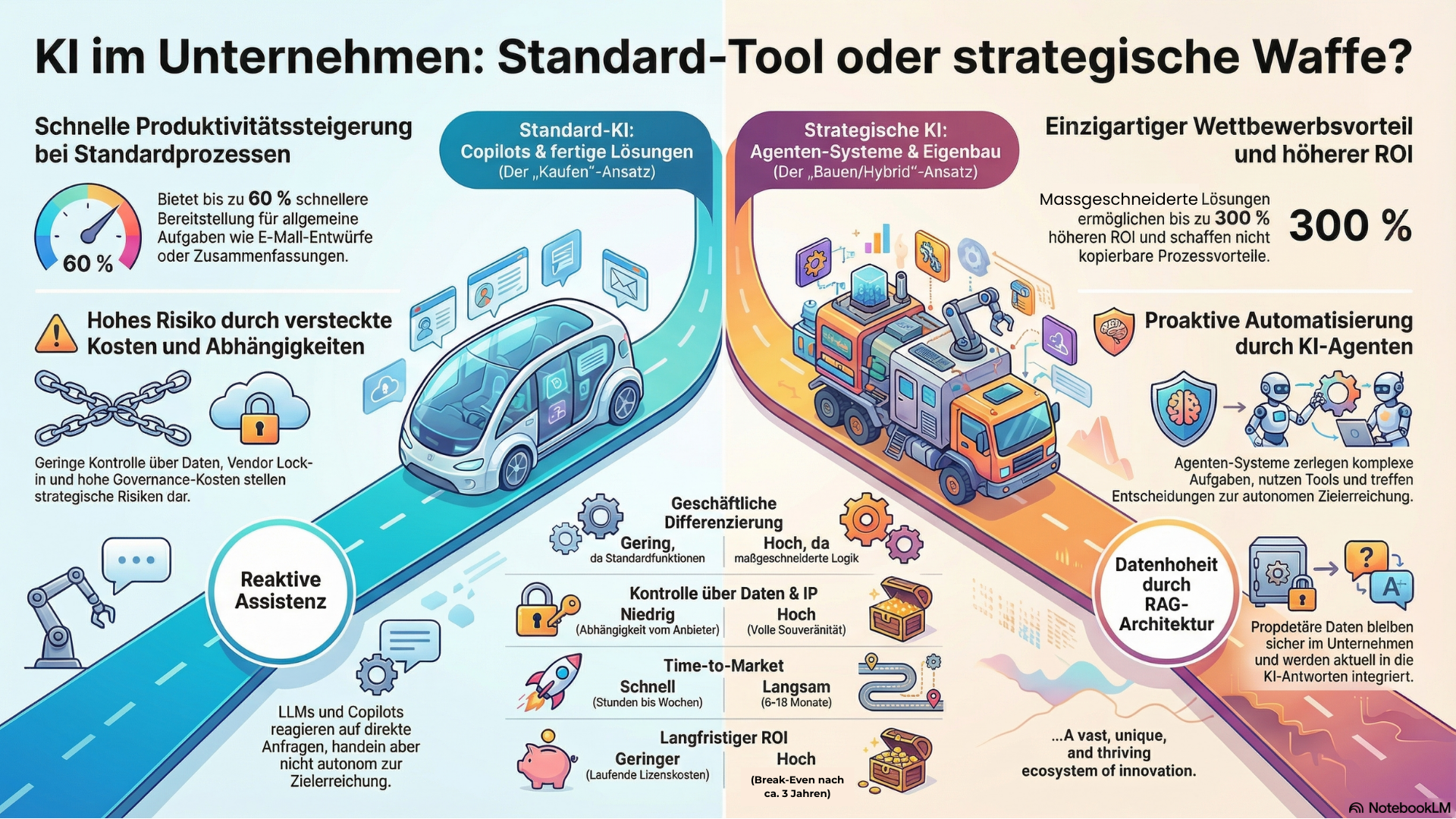
The strategic decision to introduce AI is often mistakenly reduced to the question of "buy or build?" However, the most pragmatic and successful solution for most companies is neither purely purchasing a standard solution ("buy") nor developing everything in-house ("make"). The strategically superior approach is a hybrid one.
This middle ground combines the best of both worlds: the fast time-to-value of standard solutions with the differentiation and control of in-house developments. The concept can be summarized in a simple formula: "Buy the core, make the difference." Companies use a proven, scalable standard platform as their technical foundation, such as a tried-and-tested chatbot framework or a backend platform, and build on this to develop their own individual, competition-critical functions. These include, for example, customized analytics dashboards or company-specific workflows that create a real competitive advantage.
This approach optimally balances costs, risk, and future viability and represents a strategic trade-off between rapid implementation and long-term defensibility.
Fact 2: Your biggest AI costs are not licenses, but governance
One of the biggest misconceptions about AI implementation concerns costs. The visible license fees are just the tip of the iceberg. The surprising truth is that governance costs, including central control, risk management, and GDPR compliance, can exceed pure license costs by a factor of 3.5.
This situation leads to a paradox: the initially cheaper "buy" approach can prove to be significantly more expensive than in-house development over a longer period of time. The running costs for standard software escalate due to several factors: Annual license fee increases averaging 8-12%, support contracts that account for 20-25% of license costs per year, and expensive API integrations that can cost between CHF 15,000 and CHF 100,000. A 5-year TCO (total cost of ownership) analysis illustrates this:

Without a solid governance structure, projects involving autonomous agents in particular are at risk of failure, as their costs skyrocket and their business value remains unclear. This danger is underscored by a forecast from Gartner that specifically refers to uncontrolled projects involving agent-based AI:
Gartner predicts that "over 40% of agent-based AI projects will be discontinued by the end of 2027 due to rising costs and unclear business value."
Fact 3: Forget about training AI with your data. Use RAG instead.
A common misconception is that companies must spend considerable time and effort "training" (fine-tuning) an AI model with their own data in order to make it usable for specific tasks. However, for most business applications, there is a strategically superior architecture: retrieval-augmented generation (RAG).
The RAG concept is simple and effective: instead of modifying the AI model itself, it is granted access to a secure, internal knowledge database. When a query is made, the system first retrieves the relevant information from this database and then passes it on to the AI together with the query in order to generate an informed and context-related response.
In order to reduce fine-tuning and improve the quality of responses, it is extremely important that data is used in accordance with its structure. Legal articles, for example, should always be indexed per article; this is the only way to generate binding and correct responses.
For companies, RAG offers three key advantages over fine-tuning:
Data security and data protection Company data remains in the secure internal environment and is not "baked into" the model weights. This minimizes the risk of data leaks and gives the company full control, as sensitive information never leaves its own security area.
Timeliness RAG enables access to real-time information from internal systems. This is essential for use cases such as inventory queries or technical support based on the latest manual, tasks that a finely tuned model cannot handle without costly and time-consuming retraining.
Compliance security Regulatory requirements such as the "right to be forgotten" enshrined in the GDPR are much easier to implement with RAG. Information can be selectively deleted from the source database without having to rebuild the entire, expensively trained AI model.
Fact 4: The real game changer is not the assistant, but the autonomous agent.
While AI assistants are already increasing individual productivity today, the real strategic change lies in the next stage of evolution: autonomous AI agents. The difference is fundamental—it is the transition from increasing individual productivity to enabling autonomous process automation.
AI assistants are reactive; they are a tool that you use. They respond to direct requests from a user, for example by summarizing a text. AI agents and multi-agent systems, on the other hand, are proactive; they are a team member working for you. They act autonomously toward a predefined business goal without every step having to be guided by a human.
An agent can break down a complex task into logical sub-steps, use external tools such as APIs, and adapt its strategy based on results. A clear example from pharmaceutical logistics demonstrates its capabilities: In the event of a transport disruption, a multi-agent system can act autonomously. One agent monitors the temperature, a second predicts demand at the destination, and a third automatically reroutes the freight if necessary and notifies all stakeholders. This is no longer assisted productivity, but resilient, autonomous process control.
Fact 5: Your AI is only as secure as your file permissions
The biggest security gap when introducing AI is often not the technology itself, but an existing internal problem: unclean and excessive authorization structures. AI systems, especially company-wide integrated assistants, act as an amplifier for existing weaknesses in data governance.
Problems such as "permission bloat" – uncontrolled proliferation of access rights – are exacerbated by AI. An assistant with access to the entire network can extract sensitive information from unsecured folders and make it available to an unauthorized employee who has only asked a simple question. The urgency of this issue is underscored by an alarming statistic: 60% of employees do not clean up their access rights to documents after a project has ended.
The conclusion is clear: preparing for AI security is primarily a question of internal data hygiene. Before you introduce AI on a large scale, you need to get your data governance under control. A clean authorization structure is the basic prerequisite for secure AI deployment.
Conclusion: Strategy beats technology
Successful AI implementation depends less on choosing the latest model and more on a smart, forward-looking strategy. The road to failure is paved with seemingly simple "buy" decisions (Fact 1) that ignore exploding governance costs (Fact 2). This problem is exacerbated by a lack of architectural foresight, such as choosing expensive fine-tuning over a secure RAG approach (Fact 3). Uncontrolled internal file permissions (fact 5) then transform powerful autonomous agents (fact 4) from a strategic advantage into an incalculable risk. Those who ignore the hype and instead focus on these interconnected strategic fundamentals will truly leverage the potential of AI.
Now that you can see beyond the hype, which of these strategic blind spots will you tackle first in your organization?
-Author: Jörg Bieri 12/16/2025