AI strategy as a driver of innovation—is that possible? Of course!
In a world where, according to Microsoft CEO Satya Nadella, "every company is a software company," artificial intelligence (AI) is becoming the key driver of value creation.
Uncoordinated proof of concepts that are not internally aligned tend to slow things down rather than speed them up.
In order to create real added value for our customers and exploit the full potential of AI, we have developed a holistic AI framework based on our own experience and in collaboration with customers.
Structure of the framework
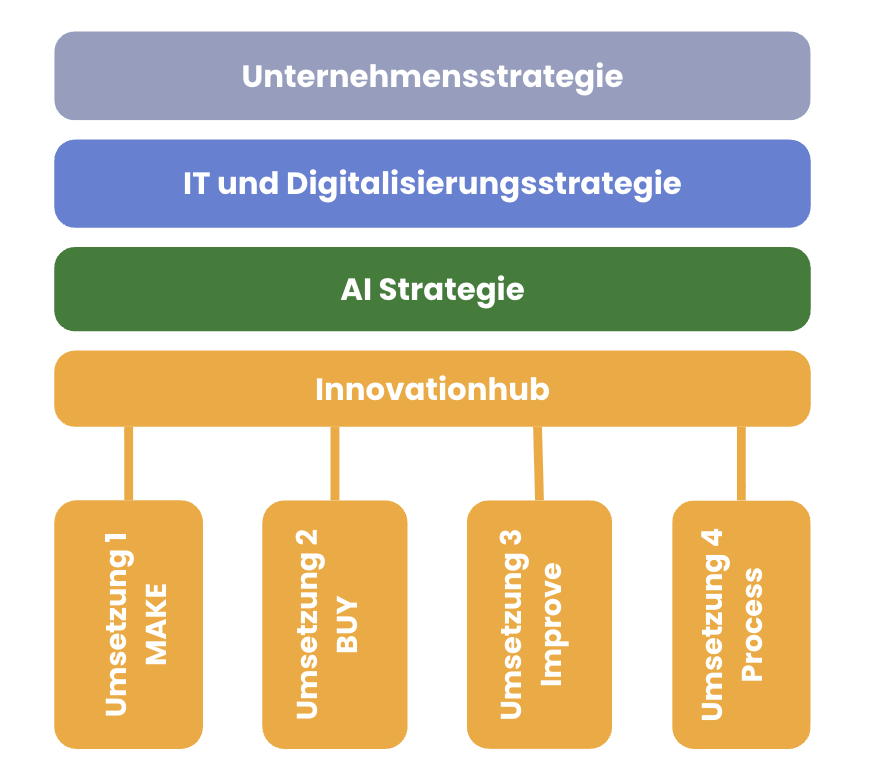
An AI strategy should never be viewed in isolation. It is the logical next step in the development of the corporate strategy and the IT and digitalization strategy. In this context, it may also be useful to have a cloud strategy in place.
To ensure that the AI strategy delivers real added value, we recommend creating an innovation hub. It collects ideas from all areas, analyzes processes, and systematically prioritizes projects according to their benefits, costs, and ROI.
Instead of major upheavals, the innovation hub deliberately focuses on quick wins that bring rapid, visible success and noticeably reduce the workload for employees.
Implementation is agile, iterative, and carried out in close cooperation between specialist departments, IT, and, if necessary, external partners.
This ensures that innovation is controlled, low-risk, and sustainably anchored within the organization.
Development of the AI strategy
An AI strategy must always be tailored to the customer in terms of content. Nevertheless, we believe the following points are important and must be included in the AI strategy.
Motivation and target vision: We clearly define why AI is being used. Typical goals include increasing efficiency, reducing the workload on employees, or measurably improving service quality.
Guiding principles: Ethical principles such as fairness, transparency, reliability, and accountability are firmly established from the outset.
Target images: We develop concrete, tangible visions, such as fully automated end-to-end processes or predictive decision support through data-driven analyses.
AI empowerment
Without a stable technological and regulatory foundation, AI remains an experiment.
Data management and governance:
Data is the fuel that powers all AI. Our framework defines clear rules for data classification (internal, confidential, secret) and binding protective measures.
Architecture:
The overall IT architecture must be clearly defined and show where AI can be used. This applies not only to technology but also to data management.
Cloud basis:
Are cloud services permitted, and if so, to what extent? Can native services be used, or are only agnostic approaches permitted? What is the cloud exit strategy?
Risk management:
We systematically address risks such as bias, lack of traceability, and cybersecurity threats, based in part on established standards such as the NIST AI RMF.
Innovation Hub as a driver of AI and innovation
Successful AI initiatives are always business-driven, never an end in themselves.
Innovation Hub as an incubator: We create a clear framework in which ideas are collected in a structured manner, prioritized (benefits vs. effort), and implemented in an agile manner.
Focus on quick wins: We deliberately start with use cases that deliver high benefits at a manageable cost. This creates trust and acceptance.
Role model: Professional responsibility (service owner) and technical operations (AI service manager, MLOps) are clearly separated and neatly orchestrated.
People and culture
AI only reveals its value when people understand, accept, and use it sensibly.
Digital literacy: We empower employees through role-based training and low-threshold formats such as lunch and learn sessions.
Human-in-the-loop: AI supports and prepares, but the final decision always remains with humans.
Change management: Employees are involved at an early stage, and the goals and effects of AI implementation are communicated transparently.
Conclusion
A successful AI strategy is not a static concept, but a living document.
Our AI framework combines technology, governance, and cultural change, ensuring that innovation does not arise by chance but is used in a targeted manner to strengthen long-term sustainability.
To save you from having to start from scratch, we have developed various templates, tools, and procedures that you can benefit from right away.
Jörg Bieri will be happy to assist you . jeorg.bieri@rwai.ch, tel. 079 594 01 61.